Swimming in Soil

Moles receive a lot of grief as yard and garden pests, but these utterly unique creatures are a vital part of healthy soil ecosystems.
When four-legged mammals (tetrapods) evolved from fish 400 million years ago, they converged on a completely new body plan by shifting their limbs under their bodies. We take the familiar upright stances of birds, mammals, and many reptiles and amphibians for granted, but this posture is actually an efficient evolutionary solution that helped tetrapods become some of the Earth's most successful organisms.

Given this context, it's surprising that one small group of mammals went in an entirely different direction by adopting a sprawling posture with their limbs permanently oriented to the sides of their bodies. Despite this awkward-looking body plan, moles have become the undisputed masters of their subterranean worlds, and it all comes down to how they've learned to "swim" in the soil.
Moles are more accurately known as "humeral rotation diggers," but it helps people visualize what they're doing if you imagine that moles are doing a type of swimming breaststroke in the soil. In other words, moles dig surprisingly fast (up to 18 feet per hour in soft soil) by extending their forelegs in front of their faces with the backs of their hands pressed together, then scooping soil outwards and backwards as they push forward, much like a person swimming a breaststroke.
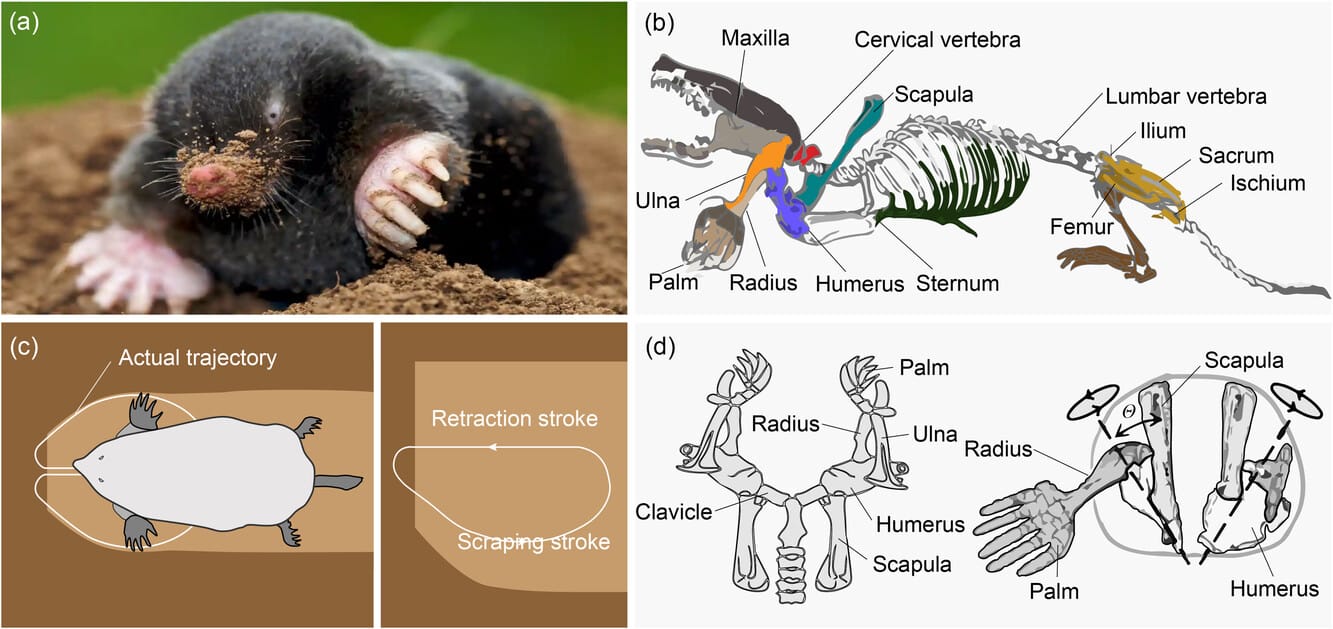
So, that's an easy explanation of how moles move, but as is often the case, the real story is far more complicated and would involve a deep dive into a highly technical explanation of bones, muscles, and physics that I can scarcely understand.
Ultimately, moles make two kinds of tunnels that involve different types of digging: Feeding tunnels that are long, shallow runways best seen as ridges of dirt running across the ground, and deep tunnels that are marked by mounds of dirt (mole hills).
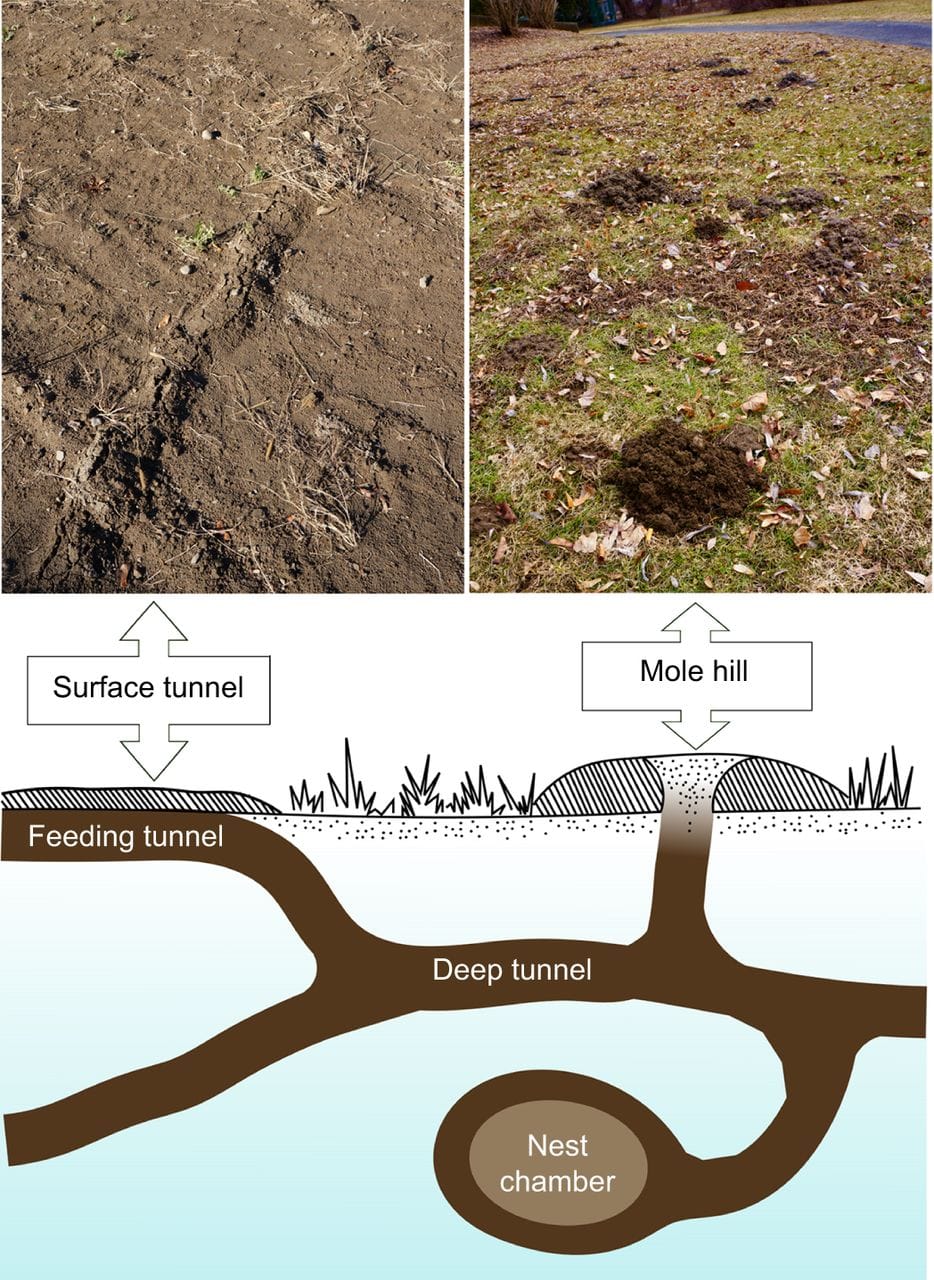
The daily lives of moles depend on both of these tunnels, with hours-long periods of feeding and tunnel maintenance alternating with hours-long periods of sleeping in deep nest chambers.

Feeding tunnels are particularly interesting because moles walk back and forth, eating earthworms, grubs, and other invertebrates that fall into these tunnels. We commonly think of moles as digging animals, but moles actually spend much of their time walking and will cover the equivalent distance of a human walking nearly 3 miles a day.
When digging their shallow feeding tunnels, moles do a weird motion where they twist the front half of their bodies, while pressing one hand against the ground for stability, and pushing the other hand upwards to raise the roof of the tunnel and compact the soil.
It's a little hard to see, but notice how the mole turns its body and uses one hand to brace against the ground, while its other hand pushes dirt upwards against the roof of the tunnel. Video from Lin et al.
In the case of deeper tunnels, a mole can't simply create a tunnel by pushing the roof upward, so they revert to using alternate strokes of their forelimbs to loosen dirt while also pushing it backward under their bellies. When they've built up a substantial amount of loose dirt, they turn in the narrow tunnel and use one outstretched hand to shove dirt upward while pushing their body along with their three other limbs.
This video briefly captures how a mole will scrape with one hand, then starts to turn in place to begin pushing dirt up the tunnel. Video from Lin et al.
What makes all of this possible are extreme modifications to skeletal and muscular structures that allow moles to push their hands outward and backward with a force that is over 30 times their body weight. Scientists are still trying to figure out exactly how all these pieces work together, but it's not easy to research these questions when moles spend most of their lives hidden underground.
Additional Resources:
A short video explaining how moles dig
A glimpse at the unique lifestyle of the star-nosed mole
How moles destroy your lawn: the forelimb kinematics of eastern moles in loose and compact substrates (this technical paper is the source of several images in today's newsletter and it illustrates how complicated the study of mole mechanics can be).
How moles walk; it's all thumbs (a technical paper exploring the mechanics of how moles walk)

Member discussion